Category: Designer Diary

  • Life after the contest

    Life after the contest

    Design Diary – December 07, 2025

    Unusually written by the designer himself, spellchecked by AI.

    The design contest ended a week ago and I have had some time to think about the next steps. Unfortunately, I have no idea how the game was received, as only the top games in each contest category were named.

    This is not too big of a disappointment, as there were so many great games in the contest. Congratulations to all designers who got their game to the podium! The games were great and all winners deserve their place at the top. If you have not checked them out, you really should do so: https://boardgamegeek.com/thread/3536713/2025-54-card-game-design-contest

    Missing feedback

    What is a bit of a disappointment to me is that I did not get any feedback on Hack-a-Pad from other contestants, good or bad. Getting feedback and learning is one main reason for me to participate in these contests. Well, one can’t have it all. Luckily, I’ve had an opportunity to playtest the game outside the contest and received constructive feedback that way.

    Based on the feedback from live playtests, I’ve concluded that the game has a lot of potential. It also seems that hacking a pad is not something everyone sees as engaging or interesting, but those who do seem to really like the game and want to play more than once. This indicates that the game is not for everyone, but there is definitely a group of people who like it. Now my job as a designer is to make it irresistible for the people it is for.

    Future development ideas

    I will be continuing the design process now that I’m more free from the 54-card only limit of the contest. First things to do now, is to figure out more stable way to track AP and Privacy (perhaps spinners or player boards?) and to reintroduce mechanics for 3-4 (or even 6) player game that requires more cards. I’m also considering to create a solo player rules. So there is much to do with the game.

  • Final Tweaks Before the Contest Deadline

    Final Tweaks Before the Contest Deadline

    Design Diary – October 13, 2025

    Transcribed by AI, dictated by the designer while driving.

    As the contest deadline approaches, I’ve been making the final tweaks to Hack-a-Pad. The game is almost ready, and I’m feeling a mix of excitement and nervousness. I’ve been refining the rules and making sure everything is as polished as possible. I also recorded a 12-minute playthrough video to give people a better idea of how the game works. It’s not perfect, but it’s a start.

    Digital Versions

    In addition to the Tabletop Simulator mod I made earlier, the game is now also available in screentop.gg. I hope that helps me to get more testers as screentop.gg is a free-to-play system website.

    Deadline approaches

    Overall, I’m feeling good about where the game is at. It’s been a lot of work, but I’m proud of what I’ve accomplished. Now, it’s just a matter of making sure everything is ready for the contest deadline on October 15th. I’m hopeful that the game will be well-received, and I’m excited to see how it does in the contest.

  • Fine-tuning and positive surprises

    Fine-tuning and positive surprises

    Design Diary – September 24, 2025

    (Note: This entry was dictated by the designer while driving a car to work and transcribed by AI.)

    Version Update

    It’s been a while since my last entry—two hectic weeks, but I’ve made progress on Hack-a-Pad. I’m currently on version 1b.1a, which means just minor tweaks—spelling fixes and a few icons—no major changes.

    Event Feedback

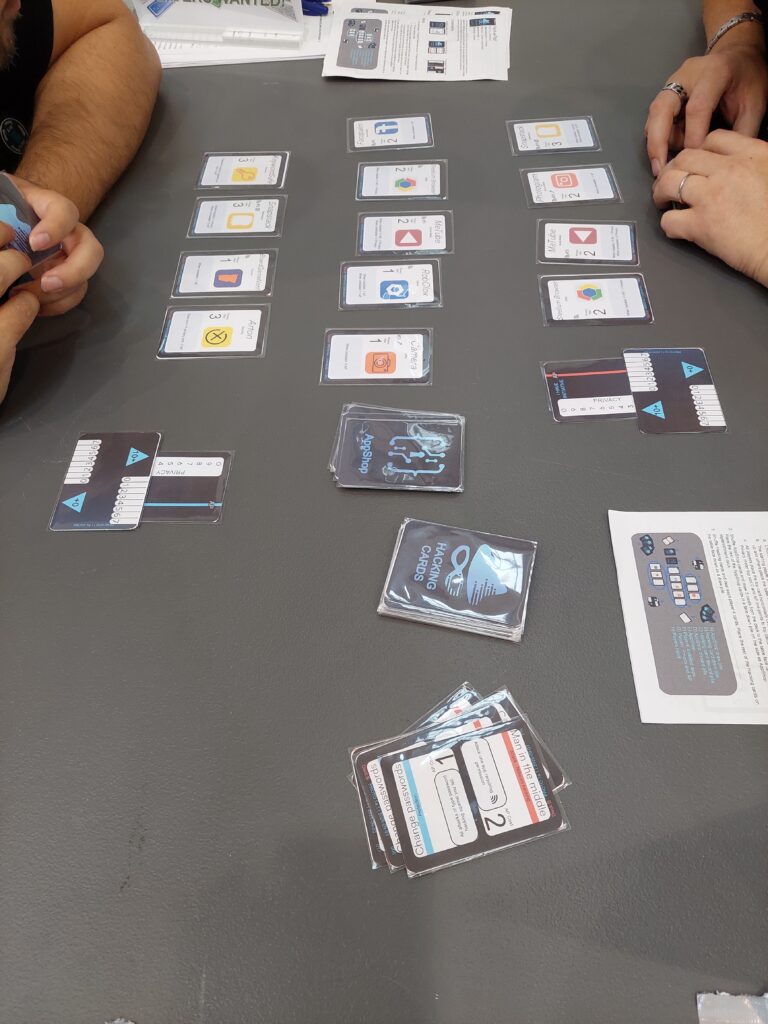
    Playtesting Hack-a-Pad in Lautapelaamaan 2025 event

    I took the game to the Lautapelaamaan event in Helsinki, and to my surprise, all the feedback was quite positive. People had ideas for tweaks, but overall, they liked it. That’s really encouraging for a game that’s only been in development for about a month and mostly tested by me and my daughter.

    A Note on Version Numbering

    Now, about version numbering: I use a system where the first version is 0.0, with the first digit representing the component version and the second representing the rules version. When I have a version that I can show to others, it becomes 1.0, meaning it’s the first full component version with some kind of documented rules. For minor tweaks like spelling corrections, I just add a letter (like 1a, 1b), so the core version number only changes with major updates.

    New Platforms and Next Steps

    I’ve put the game on Tabletop Simulator to get more feedback and I’m considering adding it to screentop.gg. I also made a print-and-play version that saves ink by not requiring certain card backs. And yes, I still need to do a tutorial video, even though my first attemptwas a bit rough.

    Overall, we’re on track for the October deadlines. The game should be component-ready by October 1st and contest-ready by October 15th.

  • Some progress and PnP files done

    Some progress and PnP files done

    Design Diary – September 1, 2025

    (Note: This entry was dictated by the designer while driving a car and transcribed by AI.)

    I made unexpected progress today on the rulebook for Prototype 1.1. Writing rules always gives me a much clearer picture of how the game is actually supposed to work — and what’s still unclear. Just like always, I found some things I thought were obvious in my head but turned out hard to express cleanly. That’s a good sign something needs refining.

    I also looked back at the feedback from recent playtests with family and friends. One thing stood out: the start of the game still feels a bit too slow. So I changed the starting hand size and initial app install counts slightly to get things moving faster. Now it seems that playtime is about 30 minutes which was my target. This also makes early decisions more meaningful, which is a bonus.

    Another small step forward: I’ve started prepared the print-and-play files for upload. They’re not fully polished yet, but I want to get the ball rolling so I don’t get stuck doing everything last minute. You can find them at https://wannabeboardgamedesigner.com/board-games/hack-a-pad/proto-1-1/

    All of this is part of my prep for the Lautapelaamaan event in Helsinki, which is now only a few weeks away (Aug 12-14). I plan to bring Hack-a-Pad there alongside my other prototypes, so I want everything to be as smooth and testable as possible by then. Every day counts at this point.

  • First playtest done

    First playtest done

    Design Diary Entry – 24th August 2025

    (Note: This entry was dictated by the designer while driving a car and transcribed by AI.)

    Last week was a pretty busy one, but I finally had a chance to start playtesting Hack-a-Pad. The good news: the core idea is working quite nicely. I ran numerous tests by playing solo, taking turns myself, and also involved my family in a few rounds. It’s been great to see it come to life and actually work on the table.

    However, I’m a bit concerned about the game length. I’m aiming for a 20-30 minute game, but right now it’s stretching more into the 30-45 minute range. I’ll need to tweak that timing.

    I’ve also realized I need to balance the cards a bit more. I’ve split the actions into three types: attack actions that target the other player’s apps, protective countermeasures to defend against attacks, and maintenance actions to boost privacy or uninstall unwanted apps. So that division is feeling good.

    Next week, I’m going to start writing the rulebook and refining the rules. I’ve already adjusted the game flow a bit—now we have a marker for initiative each round, and the player with initiative installs an app first. Then they take actions, and the other player can respond with counters. Once the first player finishes, the second player takes their turn, and so on.

    I’m hoping to have a first draft of the rules and a real card set ready for wider testing in about two weeks. Let’s see how it all comes together!

  • Designing cards and removing unnecessary mechanics

    Designing cards and removing unnecessary mechanics

    Design Diary Entry – 17th August 2025

    (Dictated by the designer and transcribed by the AI while the designer was out picking raspberries!)

    This weekend has been all about refining the card designs for Hack-a-Pad. I already had the basic card types sketched out, but I used my limited time to really nail down the actual card content: what kinds of applications, hack actions, and protective actions we’d have. The good news is that I’ve got a printable PDF ready to go, and I’m planning to start some prototype testing with my family early next week.

    I did simplify the mechanics a bit. Originally, I wanted a hidden “backdoor” hack mechanic, but I realized I just don’t have enough cards in a 54-card design to make that work smoothly. So now it’s a little more straightforward: players will install and uninstall applications and then choose from different hacking or defensive actions during their turn.

    Right now, I’ve got about 24 application cards covering roughly 17 different applications, and about 26 hack action cards, each with two possible actions to pick from. Some cards might give you more or fewer action points—starting at a base of four per turn, up to a max of seven. I also decided that applications can trigger effects when installed, at the start of each turn, or when uninstalled, which should add a little strategic depth.

    Whats next?

    I’m hoping to kick off testing next week. Since this is for a contest, I also want to make time to check out other contestants’ games and offer them feedback, even though it’s going to be a busy week at work. Plus, I need to update my Jewel eXchange rulebook for the Lautapelaamaan event in September. But we’ll see how it all goes!

    And that’s where we are right now. Let’s see what the playtests reveal!

  • First card design prototypes

    First card design prototypes

    Design Diary – August 14th 2025

    (Note: This entry was dictated by the designer and transcribed by ChatGPT while the designer was fixing a wall in an outbuilding.)

    Today, I left my day job a bit earlier than usual—just about 45 minutes early—because I know I’ll be working late tomorrow and over the weekend. I’m a bit worried that I won’t have much time for game design during the next couple of days, since family time is my priority when I’m off work and this is just a hobby. But I still wanted to squeeze in a bit of progress today.

    I’m not an artist so I use stock images

    With that extra time, I managed to create the rest of the card drafts for the game. I used some stock images from Freepik with the right licenses so I could make the cards look at least decent, even though I’m no artist. I worked on the hacking cards, improved the app cards, and designed the card backs. I also did some first tests for the action point and privacy tracking cards and even put together a simple logo using those stock images, just so I have something for now.

    Next, I’m going to dig up my old notes with card ideas and start adding them into a spreadsheet so I can create the first prototype cards.

  • Regrets and first card design

    Regrets and first card design

    Design Diary – August 13th 2025

    (Note: This entry was dictated by the designer and transcribed by ChatGPT.)

    Last night, I already started feeling a bit of regret about entering the contest. I feel like I might be in over my head because I have so much else going on. I really want to give my full attention to my two main designs, Cats on the Table and Jewel eXchange. I’ve planned to demo both of those in September at the Lautapelaamaan board game event in Helsinki, and I want them to be just right. Plus, I know my day job is going to be really busy this autumn.

    But what’s done is done. I noticed my VIP entry for the game got a thumbs-up already, so someone’s seen it, and I’m not going to withdraw. I’m going to make this happen no matter what it takes.

    Little progress everyday

    This morning, I used my time to write rulebook changes for Cats on the Table, and otherwise, I’ve been busy with life. I know I need to make at least a little progress on this contest entry every day because everything has to be ready by October 1st.

    So I opened up Tabletop Creator Pro and started designing the first prototype cards digitally. I know it would probably be faster and better to start designing on paper by hand, but I want to make sure I have a digital print-and-play version ready when the time comes. So this time, I’m starting from the beginning with all drafts done digitally. This might be a mistake, but its my mistake to make.

    I designed my first app card—the “Facepalm” app, a parody of a social media app. Uninstalling it will give the player an extra action point for that turn, just for a thematic touch. It’s a simple start, but at least it’s something, and now I have a base to work from.

  • Entering Hack-a-Pad to the 54 card design contest

    Entering Hack-a-Pad to the 54 card design contest

    Design Diary – August 12th 2025

    (Note: This entry was dictated by the designer and transcribed by ChatGPT, as the designer was multitasking hands-free.)

    Today, I officially decided to jump into the BGG 54-card design contest. I hoped to do a 24-hour contest again because I had some unexpected success last time. This time the 24-hour contest had keyword “PAD” as a theme. But since my vacation ended, I didn’t have the time. So this 54-card contest felt like a more realistic option. Especially as I have a tendency to design games with more cards this seemed a good way to limit myself.

    I’ve been brainstorming Hack-a-Pad for a couple of weeks and used last couple days to draft few pages of notes on cards, mechanics, and layout. The idea is a two-player game where each tries to hack the other’s tablet. For tracking health (the “privacy” bar), I was inspired by Star Realms’ use of two cards to track a player’s authority and adapted it here.

    Core game play idea

    The core gameplay revolves around installing and uninstalling app cards while managing action points and trying to breach the opponent’s defenses. There are two main types of cards: App Cards, which simulate various (often humorous or risky) tablet applications, and Hacking Cards, which provide different offensive or defensive actions. Each hacking card contains two different features—one on the top half and one on the bottom—so players must choose which to use, effectively doubling the variety of play options.

    I figured I needed a way for players to pay action points to play hacking cards. Because of the card limit, I combined the health and action point tracking into the same set of cards. That means the same cards track privacy and action points.

    Do I have enough time for this?

    I have to admit I’m a bit worried about finding the time for this design because I also want to focus on two other designs and get them pitch-ready this year. I’m a little afraid I might end up regretting entering this contest because I have so much on my plate. But we’ll see how it all unfolds!

  • Lessons learned from 20 hour design sprint on Chlorophyllium

    Lessons learned from 20 hour design sprint on Chlorophyllium

    I developed “Chlorophyllium,” a greenhouse management game, from concept to playable prototype in just 20 hours.

    Throughout this intensive process, I encountered several significant learning points, mistakes, and valuable insights that shaped my understanding of efficient board game design.

    You can find the latest Chlorophyllium PnP files here.